
Nueces County
Energizing Conservative Grassroots in Nueces County for 2026 Elections
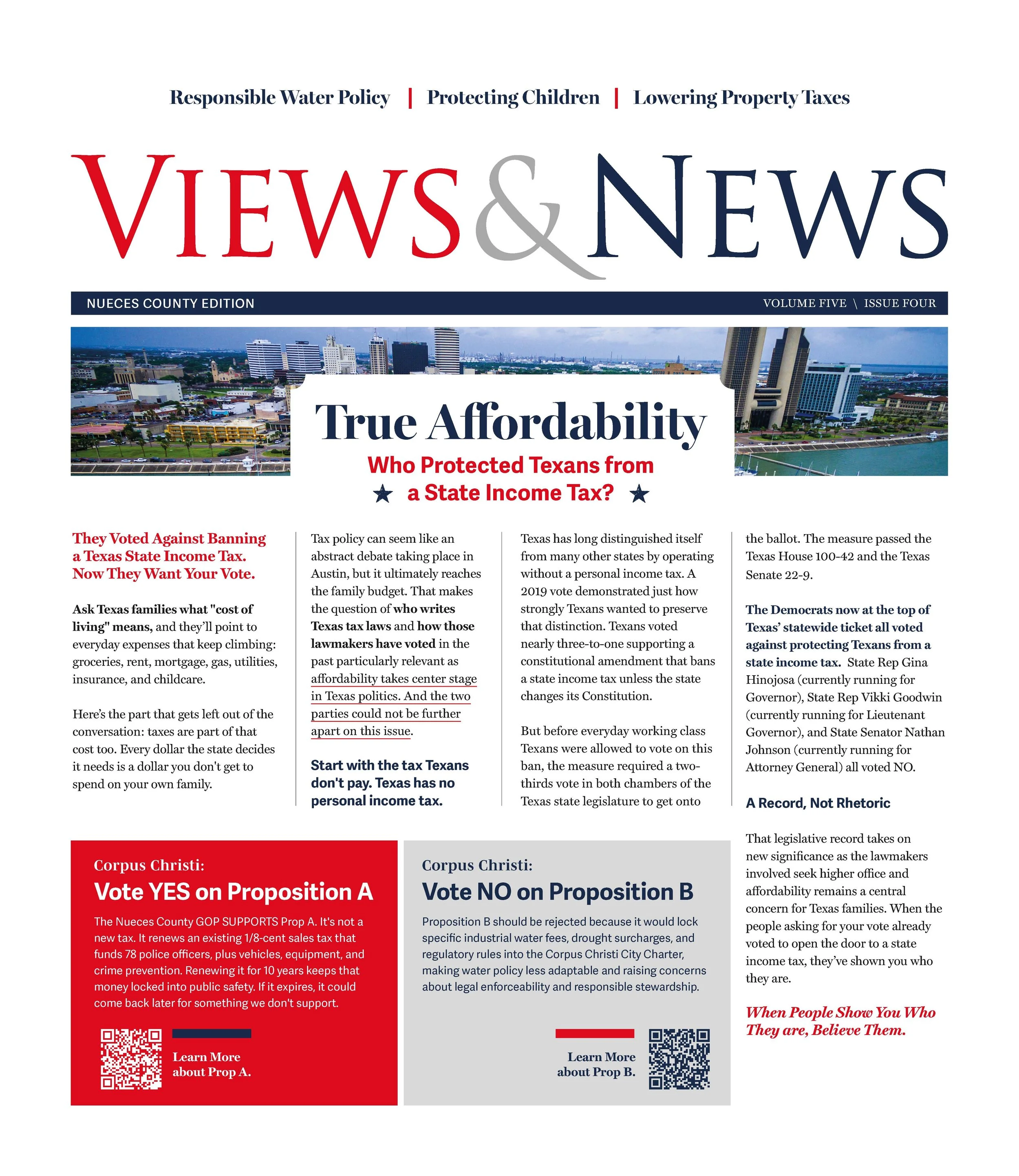
Click graphic to open the Newspaper
True Affordability in Texas: Who Protected Texans from a State Income Tax?
Ask Texas families what “cost of living” means, and they’ll point to everyday expenses that keep climbing: groceries, rent, mortgage, gas, utilities, insurance, and childcare. Here’s the part that gets left out of the conversation: taxes are part of that cost too. Every dollar the state decides it needs is a dollar you don’t get to spend on your own family.
Tax policy can seem like an abstract debate taking place in Austin, but it ultimately reaches the family budget. That makes the question of who writes Texas tax laws—and how those lawmakers have voted in the past—particularly relevant as affordability takes center stage in Texas politics. And the two parties could not be further apart on this issue.
Start with the Tax Texans Don’t Pay
Texas has long distinguished itself from many other states by operating without a personal income tax. A 2019 vote demonstrated just how strongly Texans wanted to preserve that distinction. Voters supported a constitutional amendment that bans a state income tax unless the state changes its Constitution by nearly three-to-one.
But before everyday working-class Texans were allowed to vote on this ban, the measure required a two-thirds vote in both chambers of the Texas Legislature to get onto the ballot. It passed the Texas House 100-42 and the Texas Senate 22-9.
The Democrats now at the top of Texas’ statewide ticket all voted against protecting Texans from a state income tax. State Rep. Gina Hinojosa (currently running for Governor), State Rep. Vikki Goodwin (currently running for Lieutenant Governor), and State Senator Nathan Johnson (currently running for Attorney General) all voted NO.
When the people asking for your vote already voted to open the door to a state income tax, they’ve shown you who they are. When people show you who they are, believe them.
Local Priorities for Nueces County
While statewide races draw attention, local decisions shape daily life in Corpus Christi and Nueces County. The Nueces County GOP supports Proposition A because it is not a new tax. It renews an existing 1/8-cent sales tax that funds 78 police officers, plus vehicles, equipment, and crime prevention. Renewing it for 10 years keeps that money locked into public safety. If it expires, it could come back later for something residents do not support.
Proposition B should be rejected. It would lock specific industrial water fees, drought surcharges, and regulatory rules into the Corpus Christi City Charter, making water policy less adaptable and raising concerns about legal enforceability and responsible stewardship.
Responsible Leadership in Nueces County
Connie Scott didn’t inherit an easy job when she became Nueces County Judge. She inherited years of financial challenges, neglected infrastructure, and a Commissioners Court plagued by division and dysfunction under her predecessor. Meetings had deteriorated into public arguments, business was disrupted, and at one point a meeting ended after the Court lost its quorum.
Scott brought steady leadership back to Commissioners Court, confronted the county’s financial challenges, began rebuilding its reserves, and put Nueces County in a position to tackle long-overdue infrastructure needs. For 2026-27, the county’s combined tax rate is $0.3027 per $100 valuation—still below the 15-year average of $0.3070 and the 25-year average of $0.3333. Strong investment-grade bond ratings (Aa2 from Moody’s and AA from S&P) have been maintained, employees have received cost-of-living support, and major projects such as the demolition of the abandoned 1914 courthouse and improvements at Briscoe King Pavilion and Packery Channel are moving forward. Stability, fiscal discipline, and forward planning matter. That record is worth continuing.
Protecting Victims and Protecting Women and Girls
This past session, the Texas House and Senate unanimously passed Trey’s Law, a bipartisan reform banning nondisclosure agreements that silence survivors of sexual abuse. As co-author Rep. Mitch Little declared on the House floor, “Silence is no longer for sale in Texas.” Additional reforms such as HB 4623 address school liability for sexual misconduct and failure to report suspected child abuse or neglect by waiving governmental immunity in key cases.
Over the past six years, Texas Republicans have built one of the most comprehensive sets of legal protections in the country for the privacy, safety, dignity, and fair competition of women and girls. House Bill 25 (2021) and Senate Bill 15 (the Save Women’s Sports Act) required competition according to biological sex in K-12 and collegiate public school sports. Senate Bill 8, the Texas Women’s Privacy Act (2025), requires state agencies, government-funded schools, universities, and other government entities to designate multi-occupancy restrooms, locker rooms, and changing areas according to biological sex; directs the Texas Department of Criminal Justice to house inmates by biological sex; and requires all-female state-funded domestic violence shelters to serve biological women and their children.
In every one of these fights, Republican lawmakers authored, championed, and passed the protections, and Governor Greg Abbott signed them into law. The overwhelming majority of Democratic legislators voted against these protections. The results are clear: stronger legal safeguards for women’s sports, private spaces, prisons, and shelters exist today because one side kept pushing until the laws were on the books.
A Record, Not Rhetoric
Affordability, public safety, responsible local government, accountability for abuse victims, and basic protections for women and girls are not abstract talking points. They show up in family budgets, school locker rooms, county tax rates, and the ability of survivors to seek justice without being silenced.
The Nueces County Edition of Views & News provides the full Republican candidate slate and the local voting guide for Election Day, November 3. It is legal to take inside the polls. The choice this fall is whether to continue electing the leaders who treated no state income tax, lower property taxes, public safety funding, and protections for women and girls as non-negotiable—or those whose records show they voted the other way.
When people show you who they are, believe them.
Get the next issue of Views & News for your area delivered directly to your home!